The History of the Fourth of July: How America's Birthday Began
Every July, more than 300 million Americans mark their country's birthday with cookouts and fireworks. Yet the date on the calendar hides a tangle of accidents and at least one very famous wrong prediction.
Introduction
The Fourth of July feels settled. Fireworks, flags, a long weekend, hot dogs on the grill. But the holiday you celebrate sits on top of a far messier story, and most of the "facts" people repeat about it are not quite right.
The short version: independence was voted on one day, written up on another, and signed on a third. The man who fought hardest for it expected you to celebrate the wrong date entirely. And exactly fifty years later, two of the founders died within hours of each other on the anniversary itself.
Here is what really happened, where the myths came from, and how a single summer in Philadelphia turned into the loudest holiday on the American calendar.
What actually happened in July 1776?
Independence was approved on July 2, 1776, not July 4. The document explaining that decision was adopted two days later. So the country effectively has two birthdays, and it chose the second one.
The chain of events started weeks earlier. On June 7, 1776, Richard Henry Lee of Virginia rose in the Second Continental Congress and proposed that the colonies "are, and of right ought to be, free and independent States." Congress adopted that motion, the Lee Resolution, on July 2, 1776, with twelve of thirteen colonies voting yes and New York abstaining until it received instructions (U.S. National Archives).
The vote settled the question. What remained was the explanation. A committee of five (Thomas Jefferson, John Adams, Benjamin Franklin, Roger Sherman, and Robert R. Livingston) had been drafting a formal statement, with Jefferson as principal author. Congress spent July 3 and most of July 4 editing his text, then adopted the final Declaration of Independence on the afternoon of July 4, 1776 (U.S. National Archives).
Why isn't Independence Day on July 2?
The Fourth won out because that is the date printed on the Declaration of Independence, the document people could actually read. The July 2 vote was the legal act, but the written explanation, dated July 4, became the public symbol of independence.
The text itself carried the date "In Congress, July 4, 1776" across the top. Copies were printed overnight and rushed to the colonies and the army, so July 4 was the date most Americans actually saw and remembered. The procedural vote on July 2 probably faded from public memory almost at once.
Who really signed the Declaration on July 4?
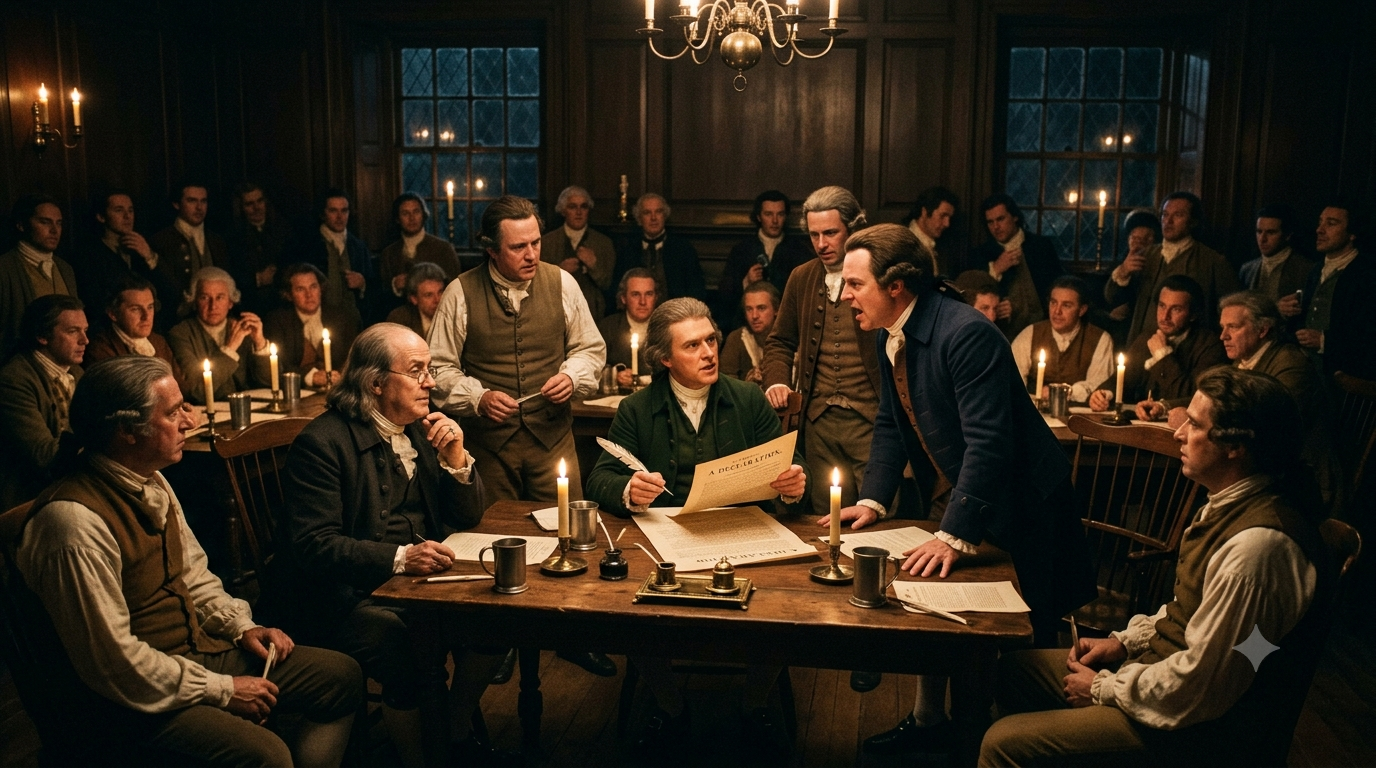
Almost no one. This is the most persistent myth about the holiday: the dramatic signing scene did not happen on July 4, 1776. The Declaration was adopted that day, but the formal signing of the official parchment copy did not begin until August 2, 1776.
After adoption, the approved text was "engrossed," carefully hand-copied onto durable parchment. Delegates started signing that engrossed copy on August 2, and the rest added their names over the following weeks and months. Several signers were not even in Philadelphia on July 4 (U.S. National Archives, Pieces of History).
In all, 56 delegates signed. Benjamin Franklin of Pennsylvania was the oldest at 70, and Edward Rutledge of South Carolina the youngest at 26 (U.S. Census Bureau). So the painting in your head, with its quills and packed room on a single July day, compresses about a month of work into one afternoon that never happened.
 ## What did John Adams predict about the celebrations?
John Adams predicted the fireworks and parades almost perfectly. He just pinned them to the wrong day, because he was certain Americans would celebrate July 2, the date of the independence vote.
Writing to his wife Abigail on July 3, 1776, Adams called the decision "the most memorable Epocha, in the History of America." He went on: it "ought to be solemnized with Pomp and Parade, with Shews, Games, Sports, Guns, Bells, Bonfires and Illuminations from one End of this Continent to the other from this Time forward forever more" (Massachusetts Historical Society).
He nailed the celebration and missed the date. "Illuminations," meaning fireworks, became the centerpiece of the holiday, exactly as he imagined. The National Archives notes that Adams genuinely expected the second of July to be the day Americans honored (U.S. National Archives). The country quietly overruled him.
How did Adams and Jefferson both die on July 4, 1826?
By coincidence, two of the document's architects died on the same day, and that day happened to be the fiftieth anniversary of the Declaration. On July 4, 1826, Thomas Jefferson died shortly after noon at Monticello in Virginia, aged 83. John Adams died several hours later at his home in Quincy, Massachusetts, aged 90.
The two men had been revolutionary allies, then bitter political rivals, then friends again through a long late-life correspondence. Adams was 90 and Jefferson 83, and both had lived to see the country they founded reach its half-century mark. Adams reportedly murmured "Jefferson still lives" near the end, unaware that his old colleague had already died that morning (Library of Congress).
To Americans at the time, the timing perhaps seemed almost scripted. Two founders, gone on the same date, exactly half a century after the words they helped write. It cemented July 4 as something close to sacred in the national imagination.
How did the Fourth of July become a national holiday?
It happened slowly, over nearly a century of unofficial parties before the government made it official. The first organized celebration came fast, but federal recognition took far longer.
Philadelphia threw the first real Independence Day party on July 4, 1777. According to the Pennsylvania Evening Post, the city marked the day with bells, a grand fireworks show on the Commons that "began and concluded with thirteen rockets," and ships firing thirteen-gun salutes for the thirteen colonies (History.com).
Official status lagged behind the festivities. Congress made July 4 an unpaid federal holiday for federal employees in 1870, and only in 1938 did it become a paid holiday for all federal workers (Britannica). For more on how the early republic built its shared rituals, see our guide to early American holiday traditions.
Where did the fireworks tradition come from?
The fireworks come straight from that first 1777 celebration, and arguably from Adams' "illuminations" wish. Pyrotechnics were already a familiar way to mark public triumphs, so Philadelphia reached for them immediately, and the tradition never let go. According to the Pennsylvania Evening Post, that night the city's bells rang and houses were lit up across town, while the fireworks show on the Commons opened and closed with thirteen rockets, one for each colony (History.com).
The early shows looked nothing like today's, though. Eighteenth-century fireworks were essentially orange explosions. The vivid reds and greens you expect now did not arrive until roughly the 1830s, when Italian pyrotechnicians began adding metallic compounds such as strontium for red and barium for green (Smithsonian Science Education Center).
So the soundtrack of the holiday is older than the color. For about sixty years, Americans celebrated under skies that were loud and bright but almost entirely orange.
 ## How do Americans celebrate the Fourth today?
On a scale the founders could never have pictured. The country that declared independence had an estimated 2.5 million residents in 1776; by July 1, 2024, the U.S. population had reached 340,110,988 (U.S. Census Bureau). That is a lot of cookouts.
The numbers around the holiday are genuinely staggering:
- Hot dogs: July 4 is the single biggest hot dog day of the year, with an estimated 150 million eaten, according to the National Hot Dog and Sausage Council.
- Fireworks: Americans set off roughly 275 million pounds of fireworks annually, an industry estimate from the American Pyrotechnics Association.
- Where they come from: Most are imported. In 2015, fireworks imported from China were worth $311.7 million out of $324.8 million in total U.S. fireworks imports (U.S. Census Bureau).
- Even the flags: That same year, $4.3 million of the $4.4 million in imported American flags were made in China (U.S. Census Bureau).
A note on those figures: the hot dog and fireworks-poundage numbers are trade-association estimates, not government data, and the Census trade figures reflect their stated reference years. They are widely cited, but they may be best attributed carefully rather than treated as official counts. For a closer look at the symbols themselves, read our piece on the story behind the American flag.
Key Takeaways
- Independence was voted on July 2, 1776; the Declaration was adopted July 4, which is why the Fourth (the date on the famous document) became the holiday.
- Most delegates signed the parchment copy starting August 2, 1776, not on July 4 as the popular image suggests.
- John Adams predicted the fireworks and parades almost exactly, but expected them on July 2.
- Adams and Jefferson both died on July 4, 1826, the fiftieth anniversary of the Declaration's adoption.
- Independence Day was celebrated for nearly a century before becoming an unpaid federal holiday in 1870 and a paid one in 1938.
Conclusion
The Fourth of July is built on a small irony: the country picked the date of the announcement over the date of the decision, overruled the prediction of one of its loudest founders, and turned a month-long signing into a single mythic afternoon. None of that makes the holiday less meaningful. If anything, the messiness is the point. Independence was an argument, not a single clean moment.
So this year, when the first rocket goes up, you will know it is echoing a wish John Adams wrote down on July 3, 1776, for a date that never caught on. Which part of the real story surprised you most, and will you be telling it at the cookout this year?
Sources: U.S. National Archives, Library of Congress, Massachusetts Historical Society, U.S. Census Bureau, Smithsonian Science Education Center, Encyclopaedia Britannica, History.com, National Hot Dog and Sausage Council, American Pyrotechnics Association.
Start Your Citizenship Journey Today
Join thousands of aspiring citizens using science-backed study tools to prepare for the USCIS civics test.